Digital Bridge Across the Border: India and Nepal Switch On Live UPI–NPI Remittances
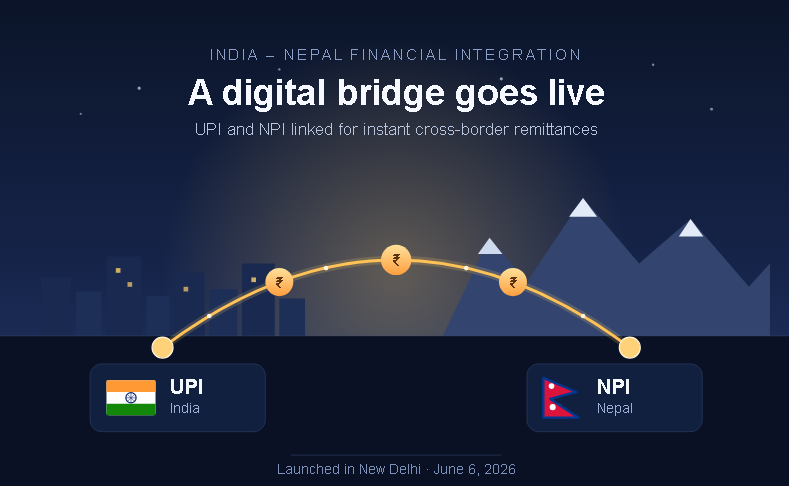
A bank transfer that once took days, multiple intermediaries and a fistful of fees can now be completed in seconds from a mobile phone. On June 6, India and Nepal operationalised the long-awaited linkage between India's Unified Payments Interface (UPI) and Nepal's National Payments Interface (NPI), allowing instant, low-cost person-to-person remittances between the two neighbours. The launch, performed jointly by External Affairs Minister Dr. S. Jaishankar and Nepal's Foreign Minister Shisir Khanal in New Delhi, turns a paper agreement years in the making into a working pipe for everyday money.
For the millions of families, migrant workers and small traders who move money across the open India–Nepal border, the change is concrete. Sending, say, 10,000 Nepalese rupees home no longer means a trip to a bank or a remittance agent. As demonstrated in the official walkthrough, the user simply selects a beneficiary in Nepal, enters the amount, validates the recipient, confirms with a one-time password, and the inward remittance lands — as routine as paying for groceries with UPI in Delhi or Bengaluru.
From signature to switch-on
The June 6 event was an operationalisation, not a fresh announcement. The plumbing was laid over three years. NPCI International Payments Limited (NIPL), the global arm of the National Payments Corporation of India, signed a Memorandum of Understanding with Nepal Clearing House Ltd (NCHL) in June 2023. The Reserve Bank of India and Nepal Rastra Bank followed in February 2024 with the Terms of Reference governing the integration. What was missing until now was live, end-to-end transactions running through both national systems. That is what the two ministers switched on.
On the Indian side the rails are run by NPCI; on the Nepali side by NCHL, operating under the regulatory umbrella of Nepal Rastra Bank. The first phase covers peer-to-peer (P2P) personal remittances — money sent between individuals — with the architecture deliberately designed to scale toward merchant payments and QR-based acceptance later.
Cheaper, faster, and built for the people who use it most
The case for the linkage rests on a simple economic logic. Traditional cross-border remittance channels are slow and expensive, layering in correspondent-bank fees and exchange-rate spreads that eat into modest sums. UPI's domestic success — built on near-zero cost and real-time settlement — is now being extended across the border. For a Nepali worker in India wiring earnings to family, or an Indian trader settling a small bill in Kathmandu, the savings on each transaction are small individually but enormous in aggregate.
The benefits map directly onto the realities of the India–Nepal relationship. The two countries share an open border, deep family ties, constant travel and a dense web of small-scale trade. A remittance corridor that behaves like a domestic payment removes friction from all of it — supporting households, encouraging tourism spending and smoothing the cash flows of small businesses on both sides.
Digital diplomacy in action
The launch is also a showcase for what New Delhi increasingly treats as a strategic asset: the export of its digital public infrastructure. UPI has already been linked or piloted with partners ranging from Singapore to the UAE, and Nepal — India's closest neighbour by almost every measure — is a natural and symbolically important addition. By offering its payments stack to neighbours, India deepens economic integration while extending the reach of a system it built and governs.
Significantly, the linkage was unveiled during a high-level visit aimed at resetting and strengthening ties. This was the first foreign-minister-level engagement since Nepal's new government took office in March 2026, and it came against the backdrop of recent friction over boundary-related remarks. In that context, a tangible, citizen-facing deliverable like instant remittances does diplomatic work that communiqués cannot — it puts the relationship to use in people's pockets.
Khanal struck a notably warm tone, stating that Nepal accords the highest priority to its relationship with India and signalling readiness for substantive engagement free of past grievances. Jaishankar, for his part, described a partnership anchored in vibrant people-to-people ties, cross-border connect and shared cultural and religious traditions, and pointed to room for cooperation in newer areas such as startups, artificial intelligence and renewable energy.
A fuller package
The payments linkage did not arrive alone. Jaishankar virtually handed over 72 health facilities and 12 cultural heritage projects — 84 in all — rebuilt by India under its reconstruction assistance following Nepal's devastating 2015 earthquake. The two sides also welcomed the entry into force of the India–Nepal Mutual Legal Assistance Treaty in criminal matters, strengthening cooperation on cross-border investigations, and witnessed an agreement between Digital India Bhashini and Kathmandu University to co-create a "voice-first" language translation platform for Nepal.
Taken together, the announcements sketch a relationship being broadened across several tracks at once — finance, health, heritage, justice, connectivity, energy and language technology. The UPI–NPI linkage is the most immediately visible of these because it touches ordinary citizens directly and daily.
What comes next
The current rollout is a first phase, and its design points clearly toward expansion. The most anticipated next step is merchant payments: enabling QR-code acceptance so an Indian visitor can pay a Kathmandu shopkeeper, and vice versa, with the same ease as a P2P transfer. Wider participation by banks and payment-service providers on both sides, higher transaction limits and integration with tourism and trade flows are all natural extensions of the same rails.
There will be operational questions to settle as volumes grow — interoperability standards, transaction caps, dispute resolution and the regulatory coordination between two central banks. But the hardest part, building cross-border trust between national payment systems, has now been done in production rather than on paper.
For two countries bound by geography, kinship and history, the significance is less about the technology than about what it removes. A barrier that made everyday money movement cumbersome has quietly fallen. From June 6, sending money across the India–Nepal border is, for the first time, as simple as sending it across the street.


Comments